
Former US President Donald Trump revealed he considered renaming the Atlantic Ocean but was dissuaded by Google CEO Sundar Pichai, who warned of international repercussions. Trump also mentioned renaming Lake Ontario to "Lake of America" and toyed with renaming rivers, while recently advocating for New Mexico to be renamed.

Atlanta Police are implementing enhanced security measures for the World Cup semi-final between Argentina and England, a match deemed high-risk due to the historical animosity between the two nations.

Argentina's football players displayed a political banner claiming "The Falklands are Argentine" after their World Cup semi-final win against England, potentially violating FIFA's code of conduct.

An Argentine war veterans federation has urged football fans to prioritise the World Cup semi-final against England as a sporting event, rather than using it to reignite sovereignty claims over the Falkland/Malvinas Islands. They emphasised diplomacy for territorial disputes and called for respect for fallen soldiers without promoting hatred.

Messi, who said he was thoroughly enjoying the ride at his sixth World Cup and giving no thought to retirement, was looking forward to locking horns with 2010 champions Spain in New Jersey on Sunday.

The Atlanta Police Department has significantly increased security measures for the World Cup semi-final between England and Argentina, two nations with a historically fierce football rivalry, deploying additional personnel and resources across the city and stadium.

'It beggars belief that Saudi Arabia would deploy military force against India, a top partner and market.'

Argentina and England are set to clash in a World Cup semi-final, marking their first such encounter, a match deeply rooted in decades of historical and footballing rivalry, including infamous incidents involving Antonio Rattin, Diego Maradona's 'Hand of God' goal, and the Falklands War.

India is significantly expanding its crude oil sourcing to Latin America, with Venezuela emerging as a major supplier, as geopolitical disruptions in the Middle East and the Strait of Hormuz compel the world's third-largest oil consumer to diversify its energy supplies.

'Control your A, B, C and D.' 'A is A1C, keep your A1C below 7 per cent.' 'B is blood pressure, so keep your blood pressure at 130/ 80 or at least below 140/ 90.' 'C is cholesterol. The bad cholesterol is the LDL cholesterol, and it should be kept below 100, preferably below 70 or 50.' 'D is discipline like diet, exercise, sleep, no smoking, etc.' 'People with diabetes who follow A, B, C and D can live up to even 100 years of age without any complications.'

If Iran and Oman choose to charge a fee for rendering services to vessels using their territorial waters, so be it. The US is indulging in an irrationally self-destructive act, notes Ambassador M K Bhadrakumar.

President Droupadi Murmu on Monday conferred seven Kirti Chakras, including two posthumously, to personnel of the armed forces displaying raw courage, unparalleled bravery and total disregard for personal safety in the line of duty.

'The flip side of this is that he won't hesitate to call out India if he thinks its policies are hurting US economic interests or border US foreign policy goals.'
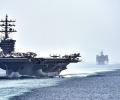
Which are the world's most vital straits, important to shipping?

United States President Donald Trump on Wednesday announced his upcoming diplomatic trip to Malaysia, South Korea, and Japan, highlighting a significant meeting with Chinese President Xi Jinping in South Korea.

Amid growing international instability, folks all over the world are wondering if there is any country that can be considered a secure refuge, should this conflict expand into a larger war, drawing in many more nations.

According to a post on X by the US European Command, the tanker violated US sanctions and was tracked by the US Coast Guard cutter Munro prior to the operation.

The clock on the ceasefire is running out. But everyone's already whispering about round two, possibly as soon as this weekend.

For weeks, the war skirted the edge of catastrophe without tipping over. Missiles flew, there was much destruction, commanders were assassinated, cities across the Gulf and even in Israel struggled to absorb the shock. But one line held: Energy infrastructure, the arteries of the global economy, remained largely untouched. That is no longer true. Prem Panicker continues his must read daily blog on the Gulf War.

Karex, the Malaysian company that makes roughly one in five of the world's condoms -- about five billion a year, supplying Durex and Trojan among others -- announced this week that it is raising prices by up to 30 percent. The reason is the Strait of Hormuz.

The IRGC had announced earlier that it was carrying out an intense wave of attacks on US and Israeli positons throughout the region since dawn, using missiles as well as drones.

The purge in Washington does not pause the war. Strikes continue, Hormuz remains closed, and Brent crude is still dancing around $109 a barrel. For India, the command chaos in the Pentagon is another layer of uncertainty piled on five weeks of conflict that was already straining every buffer Delhi has.

President Trump asserts the US military has decimated Iran's forces and no longer requires assistance from NATO allies to secure the Strait of Hormuz, despite earlier requests for support.

...reopen for up to six months. Until then, the Strait stays nearly closed. The world pays. And no one, including the man who started this, can say when it ends, notes Prem Panicker in his must read blog on the Iran War.

The delegations from the US and Iran head to Islamabad on Friday, carrying a ceasefire that is already fraying, a Strait that is technically open and practically closed, and a negotiating agenda that would challenge even parties actually negotiating in good faith, which these groups are not. Prem Panicker continues his must read blog on the Iran War.

The cost of the war is being counted not in the corridors of power in Washington or Tehran, but in Firozabad's darkened furnace rooms, Howrah's idle casting sheds, and a barbershop in Kochi where the wait is suddenly, inexplicably, an hour long, notes Prem Panicker in his must read blog on the Iran War.

Trump may strike. He may announce productive talks and extend again. He may do both at the same time. Iran will not open the Strait on someone else's terms, so no matter what happens, that problem will remain unsolved. And the IRGC will still be collecting its $2 million toll from every ship bold enough to ask permission to pass.

Taking Kharg would give the US control over virtually all of Iran's oil exports and thus provide significant leverage, notes Prem Panicker in his must read daily blog on the Gulf War. It would also put American troops within range of Iran's remaining missiles, drones, and artillery on a piece of real estate that is just eight square miles in size, and just 15 miles from the Iranian mainland.

The 'rescue' operation occurred within kilometres of Iran's underground tunnel complex at Isfahan, assessed by the IAEA and US intelligence as holding a substantial portion of the country's 60 per cent enriched uranium stockpile. Retired senior US military officers have highlighted that the mission's footprint -- hundreds of special operators, multiple heavy-lift aircraft deep inside Iran -- appears outsized for recovering a single airman. Prem Panicker continues his must read blog on the Iran War.

The United States, which entered this war in expectation of a short, sharp win along the Venezuela model, is now preparing for deeper involvement in a conflict it does not fully control, without the allies it typically relies on, against an adversary that is not behaving as expected, in a global environment that is already absorbing economic shock. Prem Panicker continues his must read daily blog on the Gulf War.

US President Trump has issued emergency declarations for 10 states as authorities continue to prepare for frigid cold which will sweep across the eastern two-thirds of the country.

Alliances fight wars effectively only when they share an endgame. If Israel acted without US knowledge, then the military alliance is operating without real coordination at the level of strategic targeting. Neither picture is reassuring in a war that is no longer regional in its consequences. Prem Panicker continues his must read daily blog on the Gulf War.

The LPG squeeze on India's restaurant sector is the quotidian face of a deeper crisis.

'The White House lunch that Trump hosted for Munir last year came just after Munir returned from a visit to Iran, at a moment when Israel and Iran were at war.' 'Trump said after that lunch that the Pakistanis know Iran very well. He likely views Munir as a useful interlocutor that can give helpful insights on Iran.'

'I suspect that Bangladesh being given permission stuck in India's official craw, and this story was an attempt to balance the scales by giving the impression that a similar waiver had been given to India as well.'
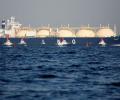
Analysts predict India will face oil price volatility and macroeconomic effects due to the escalating Iran crisis, though the country's oil supply chain is not yet structurally insecure.

The question is no longer whether the war will expand. It has. The next few days will tell us whether the war stabilises around Hormuz or whether the Strait itself becomes the trigger for a far larger rupture. What to watch for over the next 48 hours is simple: Any move by the US toward direct naval control of the Strait; any credible Iranian attempt to disrupt or mine shipping lanes and, critically, whether energy infrastructure in the Gulf continues to be targeted.If those lines are crossed in tandem, the war will no longer be containable within the region.

'Torpedoes travel at more than 100 kilometres per hour, about 50-60 knots.' 'It must have been a matter of a few minutes before it detonated under the Iranian ship.' 'The Iranian ship would have probably got three, four minutes and wouldn't have known till they actually heard the whirr of the torpedo.'

The deal shifts the US posture towards India from hostile to neutral, and that matters for growth, points out T T Ram Mohan.

Iran is fighting a different war: Older, slower, and in some ways more dangerous. Iran doesn't need to shoot down an F/A-18. It only needs to make the Strait of Hormuz feel dangerous long enough for insurance markets, shipping companies, and oil futures traders to do the rest. Prem Panicker continues his must-read daily blog on the war in the Middle East.
